

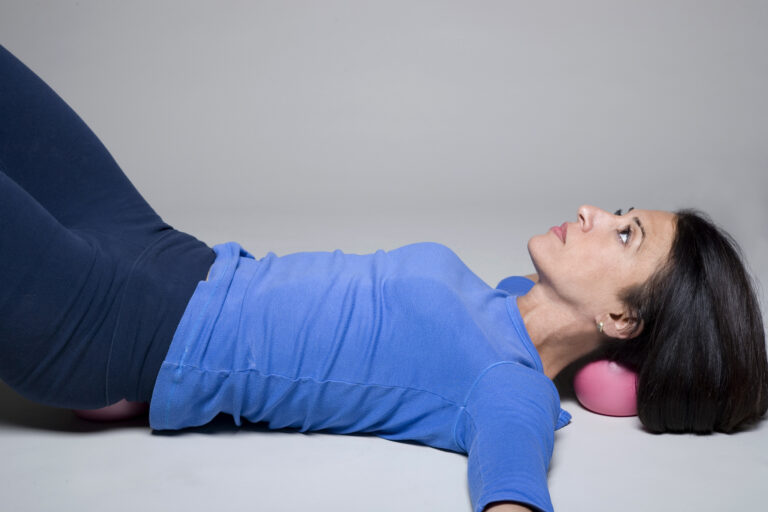
Sometimes it’s very obvious what we’re afraid of—the dark, flying, the future. It can also be something from the past that revisits us and makes us hesitate to move forward.
But what if you are afraid of your own body?
Many people live with the fear of setting off a cycle of pain, moving incorrectly and paying the price later. Perhaps you feel a twinge or one of the hundreds of physical sensations people experience every day, but immediately label it with anxious thoughts—and your body feels the effect.
We think we are protecting ourselves by being hypervigilant, but many times we are actually setting ourselves up to move with less confidence in our body.
There are huge industries that support these fears, often leaving out a key component in relieving recurring injuries and chronic pain: a deeper understanding of how your body can help you heal.
Unfortunately, most of us are not taught the power the body has to heal. Discovering and fostering that ability is a huge missing link in moving freely without fear—and in preventing recurring injuries and chronic pain.
We still believe it is all about the perfect exercise or therapy. But without this missing link, which the Miracle Ball Method is all about, you are only listening to one side of the equation: your mind.
Whether people realize it or not, most are moving primarily through thought instead of moving naturally and freely, the way children often do. We become afraid to trust the body.
What if it makes a mistake?
When Fear Shapes the Way You Move
I am not talking about injuries that occur and need immediate attention.
I am talking about when the same injury keeps recurring, or when you had a serious injury and now live with the lingering fear of it returning.
The direction your body can give you is profound. Most of us are simply unaware of it. Instead, we continue trying to control the outcome of our body through information alone.
But the other side of this equation is learning from your physical body. It speaks a different language.
We are training the body throughout our lives, but usually in a very one-sided way.
We don’t usually say we’re afraid of our body. Yet from years of working with people, I’ve seen this again and again. If you’ve experienced pain—whether from injury or illness—you are shaped by that experience.
The overlap between thought and movement is difficult to separate. Our thoughts play a major role in how we move forward and how much we enjoy being in our body.
Many people begin moving differently because of fear.
Are you moving in a way that is trying to ward off more pain?
Are you afraid of making the “wrong” movement?
I often watch people move very carefully, trying not to trigger pain. They search for the perfect exercise that will fix everything while hoping to control the outcome with their thoughts.
But the body moves quickly, processing moment-to-moment changes constantly. Most of us never consider that the way we interpret sensations and thoughts can actually perpetuate pain because we no longer allow the body to help us move through these challenges.
We get stuck in the thoughts.
The Body Does Not Move Through Intellect Alone
Bodies do not move through intellect alone.
They do not move through information alone.
And they do not deeply change simply because of a “great” exercise—especially if the fear underneath is still there.
People with recurring injuries often focus entirely on the area that hurts. But the body does not move in isolated parts.
Today’s therapies and exercises frequently focus only on the area that hurts, which is one reason lasting relief can be difficult to achieve.
The injury in your foot may be connected to the way you balance your head.
Using therapies and exercise together with the understanding the Miracle Ball Method offers can create a very different healing experience.
Without this understanding, information and therapy can remain limited. The growing number of people—young and old—living with chronic pain and recurring injuries reflects this reality.
Mind and Body Are Not Separate
Consider this:
Your mind and body are not separate.
They are distinct, but when working together they create something far more powerful.
It’s like chocolate and milk—two different elements that become something entirely new when combined.
Your thoughts and your physical body are blended together much like the ingredients in chocolate milk. The way you move is influenced not only by thought, but also by the intelligence and responses of the physical body itself.
If you rely too heavily on thoughts alone, your body never has the opportunity to do what it is naturally capable of doing to help you heal and adjust.
Most people have become heavily focused on controlling every movement and rarely experience the possibilities that emerge when the body is allowed to participate more fully.
Maybe you need more chocolate.
Begin to Trust Your Body
We can become trapped in our thoughts, and very few people explain that the body itself can make many of the adjustments necessary for recovering from injury and chronic pain.
Every time we experience a sensation and immediately interpret it as a problem, we are responding through thought.
But perhaps the body is asking us to move more—just differently.
Learning from the physical body is foreign to most of us. We are taught to control the body and assume everything will work out.
But working with your body is a partnership.
Understanding the input from your body is an unusual experience for many people, and the Miracle Ball Method helps you begin experiencing that relationship directly.
It offers another way of understanding movement.
Most exercise is still explained through the old paradigm that we must completely control the body. Of course we influence the body, but the body also has remarkable self-organizing abilities.
Many people unintentionally interfere with those abilities by relying too heavily on intellectual control while ignoring the physical input the body is constantly giving them.
The difficult part is that the body’s signals are not always comfortable or pleasant.
But how else does the body communicate that something needs attention?
Recurring injuries, tension, fear of movement, and persistent discomfort are often signals—not signs that your body is failing you, but signs trying to guide you toward a better way of moving.
Through the Miracle Ball Method, people begin to understand that the body and nervous system naturally self-adjust. It’s like having your own chiropractor inside you.
Most people unknowingly prevent these adjustments by trying to control every movement.
We are rewarded for diligence and control, but it can become exhausting.
Even breathing self-adjusts and can help relieve many of the sensations that frighten people. Yet allowing the body to do what it was designed to do can feel uncomfortable because we fear losing control.
Not All Pain Means Harm
It can feel like being caught between a rock and a hard place:
You feel pain when you are not moving, and then you feel pain when you begin to move.
We tend to label all pain as bad.
But not all pain is harmful.
Some sensations come from growth, change, and learning how to move again.
Some people become so afraid of moving “wrong” that they stop trusting movement altogether. But when that happens, the body cannot coordinate well. It cannot shift weight naturally. It cannot move freely.
And we lose the possibility of discovering something important:
Your body knows things.
And it can teach you.