Most of us have experienced the negative effects of sitting at a desk too long—
hunched over a computer screen, head forward, ribs collapsed, and pressure building in the lower back.

For many of us, this isn’t optional. It’s part of the job.
One of my sons sits at a computer at least eight hours a day. He definitely has what I call “computer body.”
Yesterday, he reached out to tell me he felt a sudden twinge in the middle of his back. He got up, moved around, and it improved. Then he thought to himself, something I’ve heard countless times:
“I have to start exercising. I’m going to the gym.”
While that may be a good idea, there are a few things you can do right now to begin undoing computer body. The Miracle Ball Method is not exercise. Your body doesn’t want to be stuck. In fact many of these twinges are the way in which your body speaks to you. It doesn’t send emails. But it is communicating. The Miracle Ball Method helps you to understand how it is communicating and cues you can use for it to be more responsive.
What Happens to the Body at the Computer
When you’re sitting at a computer for long periods of time, you’re in a stuck position.
Typically:
- The head, the heaviest part of the body, drifts forward
- The rib cage drops back and down, compressing the waist, and diaphragmatic muscle
- The shoulders round forward
- The lower back tightens
As a result:.
- Breathing becomes restricted
- Muscles become stiff and painful
- Our stress increases
When the rib cage compresses downward, it limits the ability of the diaphragm to move freely. This means:
- Less oxygen enters the body
- Blood flow decreases
- Muscles become stiff and stuck!
Holding the body in one position for long periods reduces circulation. Tight muscles + restricted breathing create the cycle for pain.
Most of us don’t have trouble breathing; we unknowingly hold our breath. Or I could say it this way, your muscles are stopping you from breathing.
Sitting at a computer doesn’t demand deep breathing. Even when you step away from the computer, most people don’t fully recover.
The rib cage stays dropped, the head stays forward, and the shoulders remain rounded.
We try postural exercises, and exercise to improve our shape and many of those might work for a while. But there is an easier way. Notice through these next few directions how your body can “un” do and reshape you. Remember earlier I said pain is not only negative. It is positive in this way. It is a warning. When we start to understand we learn it is a positive way our body is directing us to balance and realign.
Begin Undoing Computer Body
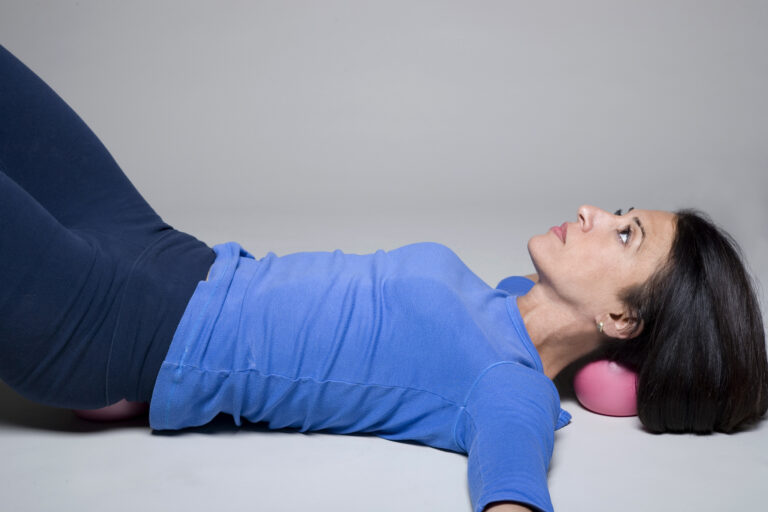
One of the simplest things you can do is lie down on the floor.

If you’re able to get on the floor, it immediately gives your entire body a sense of support. Gravity becomes an amazing asset. Use it!
Here is your Body Formula
Weight + Breath= Reduction of excess muscle tension.
These will be your cues, weight and breath. When your body begins to feel its own weight, you cannot hold your breath.
As you lie there, you may notice:
- A large arch in your neck
- Shoulders still lifted and forward
- A stiff tight lower back
- Tightness in the backs of the legs
- That you’re still holding your breath
You are not doing anything wrong—you are simply holding your body in a learned position.
Feeling and noticing sends new messaging to your nervous system and you can begin to allow the weight of your body to rest more on the floor. Your breathing responds to that feeling.
Don’t Fix it Feel It!
The Three Steps
Step 1: Lie on the floor, Notice where you’re resting on the floor—and where you’re not
Step 2: Feel the weight of your parts, weight is tangible it’s not imaginary
Step 3: Make a gentle exhalation with an S sound, then observe
About your exhalation, making an extended “S” sound. Since most of us unknowingly hold our breath, breathing out allows your diaphragmatic muscle to then pull air back in. You don’t only want air to come in. After the S sound, observe
Notice what your body does on its own.
Notice any small changes before making the sound again. Repeat this for 5 minutes.
- Don’t make it a chore
- Don’t make it uncomfortable
- Don’t turn it into an Olympic event
Remember the key is noticing any responses. No response is a response as well and it’s fine in the beginning. Your body is a bit stuck, and you might have to give it a little time. But forcing it will be exhausting.
Why This Works
By leaving your body alone, you begin to stimulate your nervous system in a positive way. Your body can give you feedback. Otherwise, it is always listening to the old messaging. Most of us are fixated on what we want our body to feel like, and pain is usually not on that list. We are always trying to change it. That is a great thought, but not how your body works. Your body changes you where you are, what you feel at this time. It doesn’t respond to where you were yesterday or where you want to go. It’s comforting in a way. When you begin to make up narratives that don’t apply to what is really happening, simply take yourself back to the physical feel. It will pay off in time. Your body will become very responsive.
Enjoy!
Next time, we’ll use a ball—which will make this process even easier.