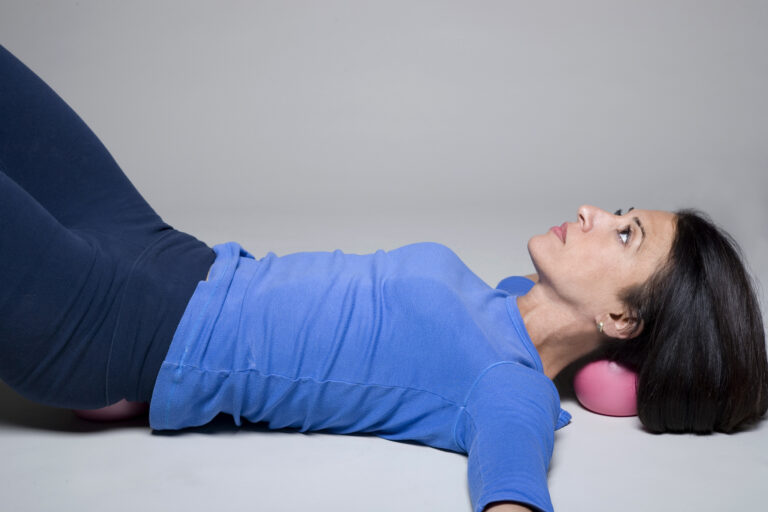
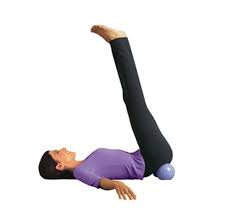
It’s always interesting when someone can’t sustain that position because the 90-degree angle is actually very strong. When you’re at 90 degrees, you’re taking advantage of half of your body going one way while your legs are moving in the opposite direction.
I asked her to slightly bend and then straighten her knees several times. Each time she did it, she bent from the knees and then straightened by locking them. As a result, her legs drifted farther and farther away from her face, and eventually she could no longer maintain that strong 90-degree position.
She wasn’t aware she was doing any of this. She kept saying, “How do I fix it? How do I fix it? I can’t stop locking my knees.”
Her lower back was compensating, and her shoulders were pressing into the floor to counterbalance.
To fix anything, you first have to slow down and embrace the way you’re doing it.
I say that with complete seriousness and confidence.
The biggest missing link for most people is feeling how they move. Which then begs the question: How is that going to fix anything?
When you do the Miracle Ball Method—or, for that matter, anything that encourages observation—you begin to notice responses in different parts of your body. You start to anticipate how you execute your movements simply by noticing more of yourself and how you achieve what you ask your body to do.
The challenge is that most of us move as this woman did, with an immediate desire to ask, “How do I fix this?”
Ironically, fixing it becomes much easier once you can feel the whole body.
That’s where the Miracle Ball Method comes in. Through your Body Dialogue, you begin to experience parts of yourself with greater clarity. You discover sensations and connections you may never have noticed before.
Then something remarkable happens. Your nervous system—not your intellectual mind—begins to organize and coordinate those parts more effectively. Instead of trying to control every movement, you allow your body to do what it was designed to do: adapt, adjust, and respond.
It’s a little like learning letters. At first, you learn only a few, perhaps just enough to write your name. Then you learn more of the alphabet, and over time it becomes more complex. Some of us even learn multiple languages.
With the body, the process is similar.
How do you fix something?
You keep feeding yourself new information. In this case that is new physical experiences.
You begin identifying different parts of yourself: your pelvis, your breathing, your shoulders, the weight of your head, the feeling of your feet.
Then the next time you do a movement like the one this woman was doing, you begin to recognize what’s happening.
“Wait a minute. I’m only pushing from my knees.”
You can clearly feel that you’re moving your legs away from your face. But because you’ve become familiar with more parts of your body, you can begin to involve more parts of your body.
The body expects experimentation.
Think about children. They are constantly trying things. Their movements often seem arbitrary and make no sense.
Why does a child’s arm fly to the right while they’re running to the left?
Why do they throw their head back while moving forward?
Why are they constantly doing strange things with their feet while sitting?
We marvel at it as if it’s something foreign, as if they have a different body than we do.
But they don’t.
We have the same body.
We just haven’t been allowing ours to function with that same freedom.
So the next time you ask, “How do I fix this?” don’t fix it—feel it.
Notice it.
As I’ve said in recent blogs, anxiety and overthinking can get in the way. The body is perfectly capable of including other parts once you’ve become familiar with them. When you begin to feel the whole rather than focus on one part, new options appear.
That’s the miracle of your body.
And that’s what the Miracle Ball Method can help you regain: the ability to feel what your body already knows.