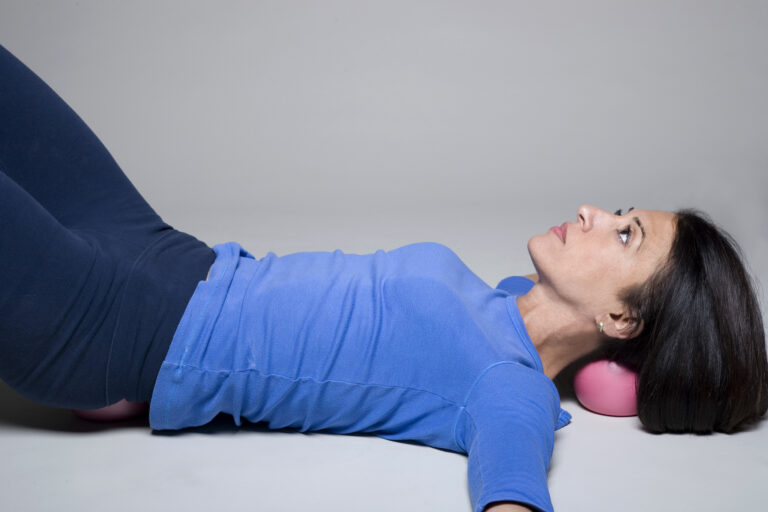
People want anxiety relief and all that goes with it. Chronic pain, a tight lower back, a stiff neck, repetitive injuries—all of these can become part of the picture when you experience anxiety.
This connects directly to how you do the Miracle Ball Method.
Don’t try to relax. Don’t try to exercise on the balls. Don’t try to make your body do something. The directions will help you understand that.
Three things are involved in anxiety, but they’re often blended together: physical agitation, the thoughts that increase that physical agitation, and changes in breathing. This leads us to what we do about it and how we perpetuate the cycle. We may perpetuate our anxiety by being afraid of it. After all, it’s pretty hard to run away from yourself.
If you think anxiety is different from physical aches and pains, or perhaps from the feeling of your breathing, all you have to do is lie down on the floor when you’re feeling anxious and notice the sensations in your muscles. Notice your breathing.
For most people experiencing anxiety, even that alone can create more anxiety. Those physical sensations can immediately trigger fears, thoughts, and worries. And, of course, those thoughts can increase the physical sensations. Your breathing can become restricted by the muscles and the response to your thoughts. Around and around this wheel we go.
When you do the Miracle Ball Method, just as you would for any reason—whether it’s a tight lower back, a stiff neck, or wanting to feel less anxious—never approach it with the intention of relaxing. Never approach it focused on the problem you have with your physical body.
First of all, the body is way too complex for that. It can do so much more for you, in a much shorter period of time, when you begin to understand how it functions.
Let me explain it like an instrument. You might be a great guitarist, a brilliant chef, or great at your job, but you are not the job. You are not the guitar. You are not the ingredients you’re putting into your pie.
That’s what people forget when they exercise. If they like to dance, do Pilates, or practice yoga, those are things they’re doing with their bodies. A guitarist makes music with a guitar, with an instrument. But the instrument, just like your body, has certain functionality that most people ignore.
Your body knows how to function. It knows how to realign. It has the ability to change how you feel physically, which can also influence your thoughts. We prevent it from working for us and train it unknowingly to work against us.
Think about trying to hold back the Hoover Dam. What I mean by that is the thoughts that come flooding in, followed by even more thoughts as you try to hold them back. It can feel overwhelming.
When we try to relax muscles that have been trained to tighten, or when the breath has been trained to be held, we’re fighting against patterns that have developed through the way we live and function in our instrument—our body. Our body is basically doing what we’ve trained it to do.
So how do we break this cycle?
For one thing, begin to understand that there are three different things going on here:
- The physicality of the body and how it gives you feedback.
- How you respond to that feedback: how you listen to it, how you perhaps run from it, and whether you become afraid of it.
- Your thoughts—what you’re saying to yourself that can fuel the fire.
But here’s where the disconnect happens. These three things are actually happening together, seamlessly. Every thought, emotion, and movement is happening in a millisecond. It has to. Your body doesn’t stop and wait for you to figure things out. Everything is connected and working together. Sometimes that can feel overwhelming, so we want to pull back on the reins. We want to control what’s happening. But you can’t do that. That’s not how the body works. The more you try to control it, the more you interfere with what it’s designed to do.
Again, you might have a room full of ingredients to make a pie. But if you’re not interested in understanding which ingredients to put together, it’s probably not going to work out. There are certain ingredients that go into making that pie.