

Do You Have Trouble Falling Asleep?
I don’t go to bed at night without doing something to “undo” what I’ve done during the day.
One of the reasons is that when I wake up in the morning, I don’t want to feel my neck stiff or my shoulders tight. I want to feel like I’ve had a good night’s rest and can move freely.
Another reason I do something before bed is that it makes it much easier to fall asleep.
My Golden Rule for sleeping, “Don’t Try to Sleep”. This is somewhat equal to someone telling you “Just relax” when you are stressed. Maybe you feel a chance for a moment, or maybe it makes you more agitated.
There are many reasons adults, especially, have difficulty sleeping:
- Stress
- A hard workout
- An injury
- Sitting for long periods of time
- Fatigue or illness
All of these can leave our muscles uneasy—agitated. That affects our breathing, and quickly we fall into a cycle of discomfort that will only get worse as. Our thoughts get involved, and all of this happens in a millisecond.
We may find ourselves tossing and turning with all kinds of thoughts, but it’s the agitation in the muscles and the lack of ease in breathing that keep the cycle going. The muscles tighten more, and the tossing and turning continues. Each part of the cycle ramps up the next parts around and around.

For many people, doing something before bed just isn’t appealing. So, let’s talk about what you can do in bed.
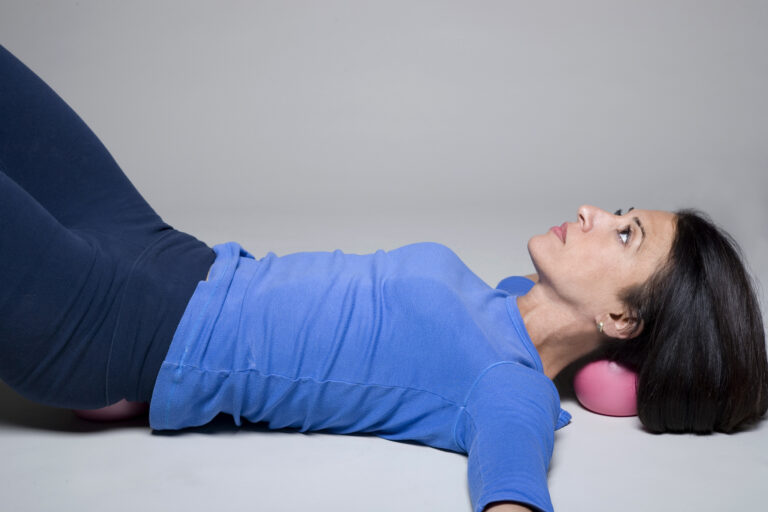
You can do the same things you would do on the floor with the balls—but in bed. And the beauty of doing it in bed is that you’re not trying to work hard.
THE BASICS:
The Body Formula—feeling the weight of the body, noticing your breathing relieves excess muscle tension.
Remember, tension is not a bad thing. We don’t want no tension. It’s the excess muscle tension, caused by many different factors, that creates agitation in the body.
The Body Formula helps relieve that excess tension. This begins to break the cycle—not only in the body, but also in the thoughts.
But we want to include a few key directions—a few key words that align themselves with our physical body rather than our imaginary one.
Your thoughts will try to dominate:
“This won’t work.”
“I’m too stressed.”
“My muscles are too tight.”
Or your mind will drift back to the day—or ahead to tomorrow.
Don’t try to stop these thoughts.
Instead, gradually introduce new thoughts or should I say directions.
Each time the random thoughts come in—or you feel a physical distraction like an ache or pain—gently bring your attention back to what you’re doing with your directions.
Using the ball, your breathing, or the small movement therapy will make it so much easier and I will introduce the small movement therapy in the upcoming free webinar on April 11th.
Trusting the Process
Let me say this clearly: what people often resist is trusting the process.
That resistance usually comes from unfamiliarity.
I’m actually a skeptic myself. I want to know something works. I’m very dismissive even before I try things. That’s one of the reasons I learned how to do this. I was getting results but kept dismissing them because I didn’t believe.
That inner fight is a waste of energy.
Yes, the body doesn’t always feel good. But the mistake people make is stopping there.
You still need to give your body new directions.
When you do, your body begins to respond in a new way. That’s a transition.
The transition is the space between stiffness and relief. It’s where you’re gently guiding yourself—with just a few simple directions.
And this is not imaginary. It’s something you physically experience.