
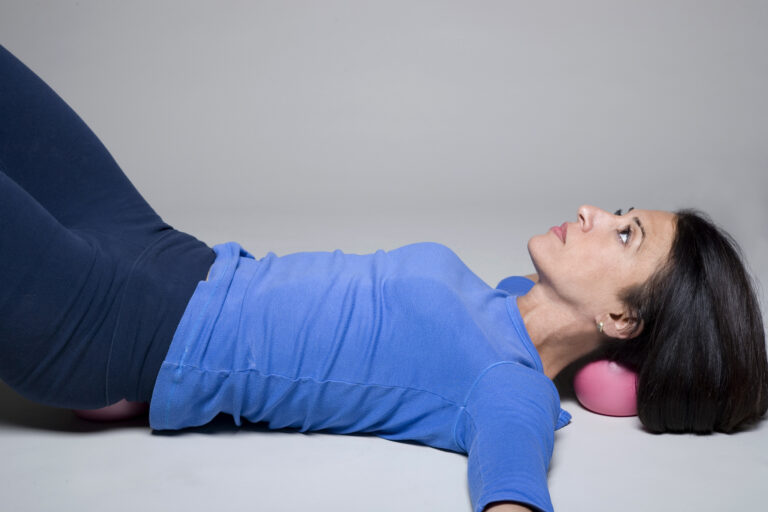
The Miracle Ball Method

The Main Ingredient

What I Saw During the Last Webinar

I wanted to write about what I saw and experienced in the last free webinar, Conquering Your Computer Body.

It’s very exciting for me to actually see people on the screen during the Zoom webinars. I completely appreciate those who don’t want to be seen or heard. But some of you do keep your videos on, and the way I teach allows me to visually see what some of you are experiencing. I can often sense it in my own body as well.

It’s all up to interpretation.

I believe we interpret life through our senses — visually, through sound, taste, touch — through the feel of life itself. Yet we don’t develop our kinesthetic sense — the sense of our physical body — nearly as much as would greatly benefit us.

To get unstuck is essential.
To notice how we are stuck is the main ingredient.

To relieve chronic complaints — the pain from sitting at a computer for long periods, from playing a sport, from scoliosis, sciatic pain, shoulder stiffness — this main ingredient is critical. It depends on how we interpret what we feel.

Someone might give you a diagnosis if you complain that your back hurts. They might prescribe a treatment. That is very different from knowing what your body is actually doing to create the problem.

Let me repeat that.

In the world of bodywork, most of us are focused on where we want to go. If you have pain or anxiety, of course you don’t want that feeling. You’re motivated to get away from where you are and go somewhere else. I completely understand that.

What I’ve learned — through a lot of early failure trying to maintain relief from chronic pain — is that I was never asking what I was doing. In my mind, whatever I was doing was wrong, so I focused on what to do next.

But the answer was in developing a relationship with how my body was giving me feedback through what it was doing — not where I wanted it to go.

Your Kinesthetic Sense Is the Vehicle

I mentioned this in my last blog and in the webinar. It is essentially the entire method: feel where you are physically rather than focusing only on where you’re going.

It’s actually not that hard to get where you want to go with the body. But you cannot skip the step of sensing where you are.

Your kinesthetic sense is your vehicle.

If you want to travel to another part of the world, you will need a vehicle. Even if you go on your own two feet — that is your vehicle. And before you begin the trip, you would want some sense of what shape that vehicle is in.

The body is no different.

What Narrative Do You Use?

Let’s return to the other senses — sight, sound, touch, taste. They are all subjective.

I could teach a class with 100 people in it, and everyone — all with relatively the same parts — will feel something different.

You could sit at a restaurant. Everyone is tasting the same meal, but not everyone will like it. One person may find it awful, another may love it.

Now apply that to the body.

We often think the body is black and white. It’s not. How we interpret what we feel is shaped by information and belief.

“I’m supposed to stand like this.”
“I don’t like moving in that direction — it feels bad.”
“Something I’m doing must be wrong.”
“It hurts, so my body is wrong.”

Your body can’t send you an email. It communicates through sensation.

But the narrative you place on those sensations is often what gets in the way.

Chronic pain remains somewhat of a mystery. If there were one universal cure, everyone would have taken it. Why do some people get results from certain treatments while others don’t? Because change happens through the senses. It’s how we experience the treatment.

You Cannot Change What You Don’t Feel

This is a lot to take in for one blog. It can be very counterintuitive to all we have known.

The method is something you learn by doing — guided in class, through the book, through practice. Its not complicated but there are very specific directions in order to develop what I’ve described in the book and the Blogs, your “Body Dialogue”. It’s the back-and-forth feedback you are always getting from your body. During the classes we acknowledge the feedback and our interpretations. We also explore what we might do differently.

As you feel more you will move more freely.

I hope you will begin to understand the directions in the webinars, through The Miracle Ball Method book, and in class and enjoy how your body does give you answers.

You cannot change what you don’t feel.

The Missing Area

As I watched people in the webinar last week, one consistent missing link stood out: sensing the area between the hips and the shoulders, your ribcage.

It sounds simple. But it’s a large region — and often a gap for our kinesthetic sense.

What if your chronic shoulder pain, stiffness, or even anxiety is connected to what’s happening — or not happening — in that space?

This week, try something simple.

When you walk, bring your attention to the area between your hips and shoulders.
What goes on there?
Does it move?
Can you sense it at all?
How would you describe it?

Don’t Fix it Feel It. Sometimes that gives your body a chance to be responsive.

When key areas of the body are left out of awareness, it’s like leaving the main ingredient out of a meal. Or taking a trip in a car with no gas.

When you begin to sense these areas — notice the narrative and begin this journey every day.

The Twinge and the Story

Humans tend to react emotionally to sensation.

“I don’t like that feeling.”
“This one is better.”
“That meal was great.”

But with the body, sometimes our emotional reaction is not an accurate interpretation.

I know this personally. After years of chronic back pain, I could feel a small twinge — and immediately break into a sweat.

“What if I can’t work?”
“What if I’m stuck in bed again?”
The “what if” spiral would begin.

And from one small twinge, the sensation would spread.

There are physiological reasons for that. The body responds to thought.

Notice how quickly you respond to sensation. Sometimes what you feel is simply information about how you just moved. It can be incredibly revealing.

But because of the story we attach to it, we run from it — and often run right back into it again.

You can’t run away from your body.

Your body is you.
It holds your history, your habits, your emotions.
It may speak a different language — but if you listen with consistency, it can take you places you never imagined.

Join Me for the Next Free Webinars

Having Trouble Falling Asleep?
Introducing Small Movement Therapy in bed with the balls.
April 11th, 1:30 ET

What Are You Afraid Of?
Moving Freely Without Fear
May 16th, 1:30 ET

JOIN HERE >>