

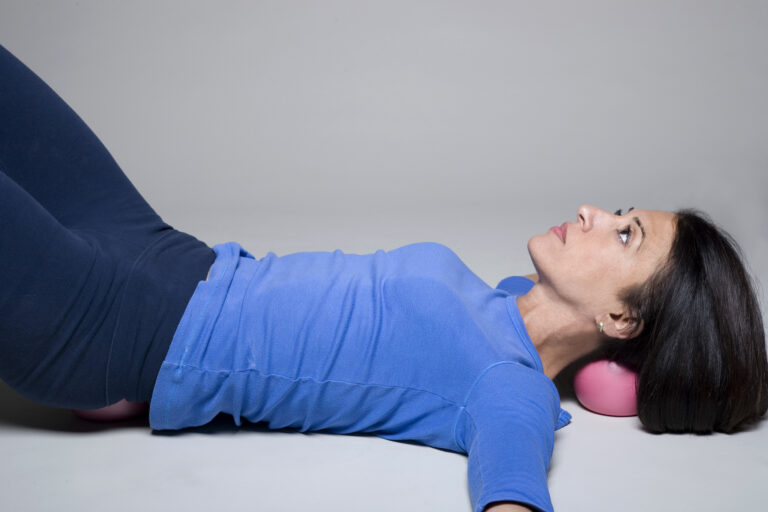
What I love about the body is its simplicity. As you become more intimately connected with your body, you realize there really are only two options. You are in a dance, moving back and forth between the two. After doing the Method for a while, you will begin to notice your body leading you more often. It takes you to a place of balance, strength, and connectedness, where it all begins to make sense.
When you go back to the other option, the old habits, the ones that hurt, that take you to a place of stiffness, holding your breath, and strain, you learn that this is the way your body talks to you. It can only talk to you through pleasure or pain. There are no emails. There are no conversations other than the ones between these two options. Except for the ones in your mind: the intellectual and the emotional. That’s another blog.
When doing the Miracle Ball Method, the directions are very simple.
Here are the two options:
Option 1 is to stay the same, which is the way we’ve trained our body to move. From my experience, this is the hardest one for people to sense. It’s very familiar, and we return to it many times even after experiencing Option 2, the relief and, for some, the realization that something has changed. That is how we learn. You can love the feeling of ease after being on the balls, feeling you are moving more freely and breathing easier. But we will go back and forth in that dance between the two options until we gain clarity on the feelings. We make choices about where we want to live.
Option 2 is allowing your body to make a change, to move out of familiar patterns and toward balance.
All of the directions of the Method create the groundwork for your body to do what it knows how to do and what it craves to do: go into balance. Balance takes the pressure off areas that are chronically stiff, helping to interrupt a cycle of pain. As adults, we unknowingly fight these natural adjustments because we train ourselves to move in certain ways. Stress plays a part, as do past injuries, illness, and simply imitating others, whether in sports, dance, or just in your family. We need options. When you do the Method, something changes, and that begins the journey.
Notice I didn’t say it begins to relax, release, or let go. Ultimately, when I use words like that, or when people hear words like that, they can begin to think that this is the goal, the ultimate reason for doing what they do. And then they don’t notice the adjustments. They don’t notice what is actually changing.
Because the directions are so simple and very specific, they can also be very easily ignored.
So the solutions you experience sometimes end with: “This feels so good. I’m so relaxed.”
“My body moves so much easier. My backache went away. My shoulder stiffness has eased up. I feel good.”
When you get responses different from what you are familiar with, take it a step further. Notice that your body has actually changed physically. Acknowledging that change through your senses allows your body to adapt to new ways of moving. You can only understand and fully own the changes when you recognize where they came from.
That, again, is the miracle, a bit beyond our understanding, I would say. How it does this, I don’t know. But without offering your body options, without allowing it to sense and feel, it remains stuck. Then you are stuck with the chronic stiffness, aches and pain, and anxiety, with no options.
The more you become connected and intimate with your body, the more you begin to recognize these changes. There is no one doing this for you.
Learning From Your Body
When doing the Miracle Ball Method, the biggest change, I would say, happens when people begin to notice what they are doing.
The first step is simply to notice. Even when you use the balls, just notice.
We assume we are breathing and feeling good because that is our objective. But that’s not the objective. If you end there, which most people do, then you miss how your body adjusted. That takes you to a completely different level, learning from your body. Our objective is to discover you. Unknowingly, most of us hold our breath and hold our bodies in a little bit of a straitjacket. Of course, when you recognize that, then “you” begin to fix it.
When you follow the directions of the Miracle Ball Method, you begin to realize your body knows best.
Don’t Fix It. Feel It.
Use the Body Dialogue I talk about in the book as your body begins to make changes and adjustments. Be specific; put a little language into it. It doesn’t have to be analytical. In fact, it’s more sensory.
You’re using your kinesthetic sense.
And then there is the other option: What happens when you allow the directions of the Method to create responses in your body? You begin to stop doing some of the things that have become so familiar to you. You start to notice that these are really patterns in the way you function in your body. And it becomes easier to move differently.
And then it becomes even easier to allow the body to use option two, because your nervous system will do it naturally. Your body has a natural desire to stop holding an awkward position, especially when it comes to the breath. The breath is often held because of these awkward positions.
Actually, that could be a chicken-or-the-egg thing. Since breathing and these physical positions are so connected, it could be that the breath is held first, which, of course, makes us hold our muscles.
I’m not sure. What matters is using your kinesthetic sense. Enjoy the feeling of doing the Method, but notice the difference between option one and option two.
Are all your holding patterns just going to disappear in one day? Is your body just going to perfectly align?
Well, I never do the Method with that objective. Those are emotional wants and needs. When I’m with my body, I like to use body time.
I like to respect that my body does know where alignment, balance, and breath are, and to learn from it where it can go.
Then the sky is the limit: moving freely, using tension, playing with movement as you did as a child, getting stronger, sitting more easily, and making chronic aches and pains history.